I Can’t Decide

The stasis in my life results largely from an inability to make choices. Countless dilemmas leave me stuck thinking “I could do this, but … on the other hand.” I think it’s probably the source of most of my pain.

I don’t know whether to stay in this house, or leave.

I don’t know whether to start counseling again …. or not.

I don’t whether to continue with my chiropractor …. or quit.

I don’t know whether to <pick your dilemma> …

Just do something, GD it. Choose!

Struggling

As the comedian Gary Gulman notes, the thing about life is … it’s every day. Every day the maintenance, the routines and rituals. And boy do I have a lot of them. I wish I could simply roll out of bed and be ready to go, but it’s a laborious process:

Roll over several times and wonder if I should try to sleep more before finally pushing myself out of bed. Change from sleep clothes (boxers, t-shirt and light fleece) into warmer intermediary clothing (for the Arctic journey from bed to kitchen to shower). Heat up coffee. Add creamer. Reheat coffee because the creamer cooled it down. Add just a little more creamer. Resist showering (Arctic chill again; thermostat is kept at a steady 50 degrees, day and night to save oil). Finally shower. Shave. Get dressed. Let Kramer out (she’s kept in living room at night and until I shower to avoid her making a move into my bedroom, the sanctum sanctorum, the only place in the house kept free of cat hair). By this time the coffee has kicked in and I need to sit on the toilet for a while. After that interlude I can, finally, sit down at my desk.

The activities above require, on any given morning, at least an hour to complete. The most precious commodity is time, and I feel as though most of mine is pissed away on stupid stuff. But, on the other hand, when confronted with shapeless time, the stuff of which notable accomplishments are made, I don’t know what to do with myself.

A Drab Sunday

Solitude has become my new normal. My resolution to avoid pursuing relationship of the female variety has left me largely to my own devices. What are the positives?:

  • It forces me to feel the feelings of loneliness that constantly arise, and to deal with them. Do I really want to call someone up/find a companion for some ostensible reason which is really just to avoid being alone? Clearly that’s the reason most people have friends, but I always end up feeling antsy, and as though there is something I want to or should be doing instead. Sooo … I’ll live with those moments for the time being, and resolve them by diverting my energy towards one of the things that I always told myself I should be doing when I was with someone else.
  • It lets me do “my thing” without guilt, except insofar as I feel guilty about being so odd. Days can be spent with the routine maintenance of this one 62-year old male …. showering him, shaving him, dressing him, preparing meals for him, and feeding him those meals. Shopping for him. Finding some recreation (usually of the video variety) for him. On a weekend day, these tasks consume the day. Somehow, on a workday, they more or less get done in and around the prescribed work activities, but it isn’t easy.
  • It makes me think more carefully about time, our most precious commodity, and how I really want to spend it. It gives me time to come to terms with my oddities, and, not judgmentally, wonder if reforming some of those oddities would make my life more enjoyable.

And the negatives:

  • I feel like a freaking weirdo. Not only do I lack family or offspring, I also lack, apparently, any human connections. This is not entirely true … I do have dance, if I want to pursue it (I was glad to go to Anne’s Manchester dance last Thursday, and she was glad to see me). I will go to visit Wendie soon. I’m hoping to make a trip on an airplane to see one of the two western Deirdres this spring or summer.
  • I become a self-absorbed monster. Any thoughts for the welfare of others are subsumed by my intense naval-gazing

My method, which one might call, “waiting for a sign,” while attempting to do the things that I always bemoaned missing out on when I felt trapped by a relationship feels suspect, and I sometimes fear for my mental health.

In Love

John gave me this book for Christmas this past December, and it was a quick read over a few days at the end of the year. This evocative novel by Alfred Hayes beautifully captures a kind of noirish vision of 1950s New York City that I find absolutely irresistible. Above all locales, this is my time, my place, and, as it is for the heroine, my weather.

Autumn, she always said, was her weather. She was always happiest when the sky was clouded over and gray, and there was a fine delicate mist in the air. Summer with its heat and it unchanging sun depressed and exhausted her.
(p. 85)

Yep,that’s me.

First Reformed

Ethan Hawke stars in this film that masterfully connects the existential struggles of an individual (Hawke as Reverend Ernst Toller) with the global threat to human existence posed by climate change.

Toller, pastor of a small Dutch Reformed church in upstate New York, is asked by a young local woman, Mary (Amanda Seyfried), to counsel her husband Michael, whose radical environmental beliefs have led him into trouble before, and who now apparently contemplates martyrdom, as evidenced by the suicide vest Mary discovers in their garage.

While counseling Michael, Toller seems to find in these environmental concerns, with their disconnect between what we know to be right, and how we behave, a correlative to the disjunction in his own life between the model person that he wearily apes as a minister, and the alcoholic, lost man that he is in private.

A.O. Scott, writing his New York Times review of the film, incisively captures the underlying source of Toller’s anxiety:

“First Reformed” feels like a horror movie, which in some ways it is. The source of the terror, though, is not a supernatural presence but a metaphysical absence. A poem by Robert Lowell records an 18th-century preacher’s feeling that “the breath of God had carried out a planned and sensible withdrawal from this land,” leaving His creatures to their own infernal devices. Toller stares into the same abyss.

Toller’s internal struggles are accelerated by the impending Reconsecration of his church, which has become little more than a picturesque tourist stop, historically notable as a former stop on the Underground Railway, but spiritually irrelevant, and mostly devoid of parishoners on Sundays. The Reconsecration, led by Reverend Joel Jeffers (Cedric Kyles) of the nearby megachurch Abundant Life,  promises to cement the irrelevance of First Reformed by incorporating it into the swelling tide of evangelical meliorism.

Toller’s dying First Reformed church, set against the successful Abundant Life church, and the easy platitudes of Jeffers, is an obvious and telling contrast. Toller understands where the danger lies; prosperity, in this film, is a form of blindness, the evidence of Jesus’ teaching that it is easier for a camel to pass through the eye of a needle than for a rich man to enter the Kingdom of God.

But the deeper complexity, the one that Scott’s review alludes to, comes from the emptiness in modern life, the awareness that we have stepped into a secular abyss that no longer offers any possible solutions. During the scene in which Michael’s ashes are scattered, a choir of youthful climate activists chant tunelessly, excoriating “big oil.” The lyrics are as platitudinous as any of Jeffers’ reassurances. One feels clearly the loss of a transcendant aspect.

The basic question that Toller seems to be struggling with is whether man can know the mind of God. His genuine efforts to understand the answer to this question are undercut by the contemporary world, which has adopted what is essentially a human-centered religion, one which creates its own norms and values, and then attributes them to God.

In this world,  Edward Baiq (Michael Gaston) , the big oil executive who dismisses climate change as “complicated,” and erupts at Toller because he wants to take “political” stances, is the personification of the approach our society takes to quell those who would question materialism. In this camp, doubt is the greatest weakness, and greed, masked by the shiny trappings of worldly success, is the greatest good.

While Toller apparently finds an escape from his own personal hell in his relationship with Mary, there’s no comparable solution to the environmental destruction Michael foretold. As in Beatriz at Dinner, another powerful recent film with an environmental theme, self-immolation is shown as a tempting recourse for the protagonist; when society seems beyond reform, is the best option to give one’s life in an example of the ultimate resistance?

Early Work

I’m impressed by Andrew Martin’s first novel, Early Work. Judging by his author photo in the New York Times review, he can’t be much over 30, but the assuredness of his writing suggests a writer capable beyond his years.

Not a lot happens in Early Work, which makes it my favorite kind of novel. I felt a kinship with his protagonist, Peter, an aspiring writer who dropped out of an English PhD program to become a writer, but instead ends up a dependent tag-along to his girlfriend, Julia, a med school student who also happens to have accomplished more as a writer than Peter, crafting published poetry in her spare time.

Peter spends most of the book figuring out a way to break from Julia in order to be with Leslie, a woman as screwed-up as he is, and by the end he is successful, with questionable implications for his future. But it’s the journey that matters, and Martin’s writing is crafted with a keen eye for the telling detail, nuanced emotional intelligence, and a sense of balance that makes a book about screwed-up people into an artistic gem.

I frequently stopped to admire Martin’s confidence in exploring a direction that, in less capable hands, might have been a boring detour, but which this writer made part of the ultimate shape of the novel. There’s an Updike-like willingness to linger over sensory details that, while not advancing plot, yield some of the most pleasurable moments of the book. Martin is writerly in a good way; he writes very well but not ostentatiously, and his skills are always used in the service of his characters.

Trump’s Border Wall

The Republicans have had full control of government for two years, and have made zero progress in giving Trump his wall. Why is funding the wall an issue now, and why is it being used as a bargaining chip on the backs of govt. workers?

To understand, I think you have to appreciate that, while Trump is completely incompetent at most things, he’s a mastermind at playing to and inciting his base. And, you have to appreciate that, despite everything Trump says about the wall being necessary to stop immigrants, its value for him is almost completely symbolic, used to pacify something very primal in his base. Trump’s campaign promise to build “a big, beautiful wall” on the southern border has served him as an extremely powerful protective image for his base, whose concerns largely revolve around fear of change, whose preoccupations are us against “them.”

If Trump was really concerned about building an effective barrIer, shouldn’t he have thought it out? I mean … he doesn’t know if he wants a fence or a wall, and he doesn’t really have any specification for or understanding of what this wall would really do, how it would be constructed, whether the money he’s asking for is really commensurate with what’s required, etc., etc. Shouldn’t he know some of these things if the wall is really important to him as a wall, and not as an image for manipulating his base?

What he really wants now is to hold out for a wall, to have a fight about whether the wall gets built, to play ridiculous games about funding … do you need $2.5B, do you need $5B, or is $20? Is steel acceptable rather than concrete, is the wall transparent? Etc. Trump doesn’t know the answer to these questions. He doesn’t care. The other obvious truth about Trump is that drama is everything for this former reality TV star. He doesn’t want this standoff/showdown/shutdown to stop, especially if it ends with him getting what he wants. Then he would have to build a wall. What fun is that?

If, on the other hand, he can continue the disagreement with Democrats, he’s a winner with his base, because he’s demonstrating what passes for principled behavior with the Trump crowd, without actually having to do anything but be stubborn. So, the government is shut down, and more and more are suffering as a result.

Somehow that downside to the shutdown doesn’t touch Trump among his supporters Why? Just listen to LIndsay Graham on Face the Nation today, who actually said “the goal is not to open up the government.” I used to think this guy was reasonable. Apparently he got too close to Trump, and the crazy rubbed off on him.

This is the inflexible logic of the Right: because they have decided that funding a border wall should be the primary concern of the U.S. at this moment in time, trumping (no pun intended) all other concerns, including the health and solvency of current U.S. citizens, they are perfectly happy to hold the country hostage to this demand. They are taking their ball and going home in true McConnell style.

Some say there should be a compromise; the Democrats should “give a little,” which is ridiculous since the Democrats have floated numerous solutions to the immigration problem. What is really meant is that the Democrats should agree to more money for a wall. Why? If someone has a stupid idea, should those who disagree with it show good faith by agreeing to a solution that’s only “a little bit stupid?” If you really believe that allocating taxpayer dollars for a wall (that Mexico was supposed to pay for) is a stupid idea, there’s no middle ground, no “partial wall” that makes sense.

Just listen to some of the newly-elected House Democrats if you want a breath of fresh air on this and other topics (see clip below). Max Rose, a Representative from NY who served with distinction in Afghanistan, nailed it re: the wall: “A shutdown should never be used as a negotiating tactic…. I”m not willing to spend billions of dollar on what amounts to a vanity project…. it’s a 5th century solution to a 21st century problem. What’s next? Rowboats in the navy? We could put Trump’s name on them.” How about Max Rose in 2020?

Exercise

How important is exercise to me? Very. Since my left hip really started to bother me, I’ve run very little. Today I got a fair amount of exercise at work, but there’s a nagging sensation in that hip that tells me all is not well, and that I had better give it rest.

I made a doctor’s appointment for Monday.

Kramer

Some days, especially when I’m working from home, she’s my only creature contact. I may not have a girlfriend at the moment, but Kramer is a steady female presence. Her eccentricities make me chuckle; her bad behaviors are so predictable and benign that they charm.

As she ages …. is she six now? I remember fostering her litter in 2012, I believe …. she becomes more set in her ways, like the grande dame that she is. At any particular time of day, she has her favored roosting spot. In the morning, she’ll often join me in my study, sitting Sphinx-like, front paws curled under, on the spare chair.

Eventually she’ll wander off to the spare bedroom (my bedroom being off limits), to another familiar nest, this one on a chair cushioned with a pillow so saturated with cat hair that it has become unquestionably her pillow. This is where the serious sleeping occurs.

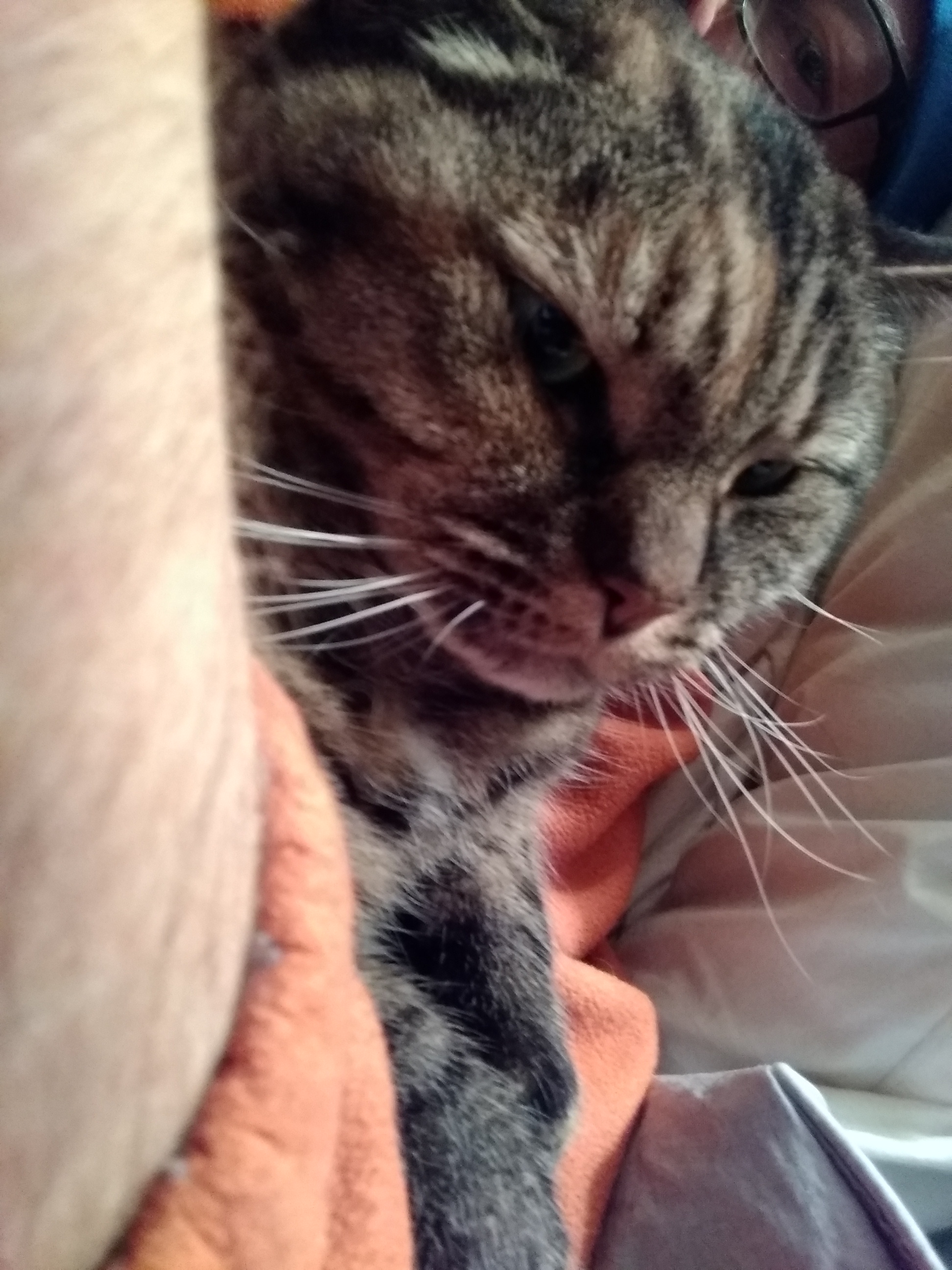
In the evening, if I’m on the couch in the living room, Kramer wanders in and out of the room, occasionally favoring me by jumping up and curling up next to me (if I’m sitting), or in the crook of my arm (if I’m lying down) (see photo). One of us will then get restless, or her cat ears will pick up a sound in the kitchen …. a mouse? the wind? a settling floorboard? … and she’ll be off to investigate. Some time later, she’ll return with her report. We’re both satisfied that, for the moment, all is well, and she rejoins me on the couch.


January 3, 2018

Digging into MadCap Flare by reviewing some old lynda.com coursework. Learned a little about Subversion, and how to integrate it with Flare.

I ran in Dover last night. It felt good, except for this damn hip thing. I have to get that checked out. Hopefully I’m not making anything worse through activity.

A decent wine, recommended by a French fellow at NH Liquor and Wine: